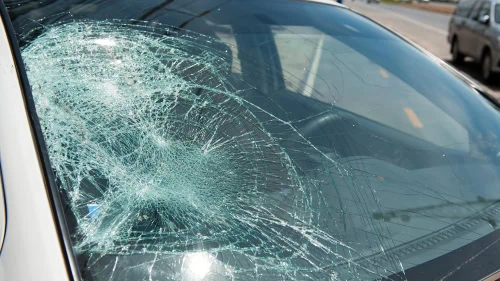
Your insurance company will default to aftermarket glass. For newer vehicles with safety cameras, that default could cost you more than you expect.
Share:
Summary:
You file a claim, your insurance company tells you they will handle it, and somewhere in the process a decision gets made about what kind of glass goes in your car. Most people never think twice about it. But if your vehicle has a front-facing camera, and most cars built after 2016 do, that decision affects if your safety systems work the way they are supposed to after the job is done.
This is not a niche concern for luxury car owners. It applies to Honda CR-Vs, Toyota RAV4s, Subaru Outbacks, and just about everything else on the road in Suffolk County today. Here is what you need to know.
OEM stands for Original Equipment Manufacturer. An OEM windshield is made by the same manufacturer, or to the exact same specifications, as the glass that came with your car when it left the factory. Aftermarket glass is made by a third party, manufactured to meet minimum federal safety standards, but not necessarily to the tolerances your vehicle was engineered around.
The federal standard, FMVSS 205, sets a floor. OEM glass is built above that floor, staying within plus or minus 0.1 millimeters in thickness and 0.5 millimeters in curvature variance, because your car’s frame, seals, and camera systems were designed around those specific dimensions. Aftermarket glass meets the legal minimum. Determining if it meets your vehicle’s exact requirements involves a separate question.
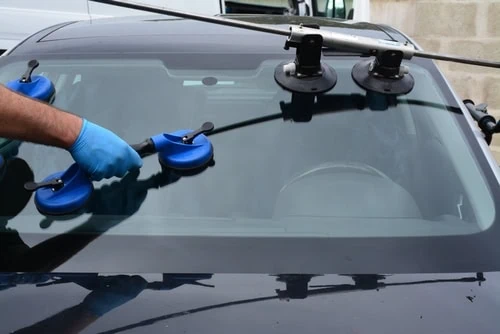
Here is where the OEM versus aftermarket question stops being abstract. Most modern vehicles use a forward-facing camera mounted to a bracket bonded directly to the windshield. That camera feeds your lane-keeping assist, automatic emergency braking, adaptive cruise control, and other systems that are now standard on most new cars.
When the windshield is replaced, that camera must be recalibrated and repositioned so it reads the road accurately. The IIHS tested 51 different vehicles and found that every single one required recalibration after a windshield replacement. That is not a rare edge case, as it applies to every car.
The problem with some aftermarket windshields is not just the glass itself, but the camera bracket. On many aftermarket units, the bracket is bonded in a slightly different position than the OEM specification calls for. That positional difference, even if it is just a few millimeters, can make it impossible to calibrate the camera correctly.
Some aftermarket manufacturers also use plastic brackets instead of metal ones. Plastic deforms under the heat generated by the camera over time, causing the camera to drift out of alignment even after a successful calibration. A 2023 study found that OEM windshields offered 12% better optical clarity in the ADAS camera zone and were associated with 23% fewer calibration failures compared to aftermarket alternatives.
Technicians regularly report that when ADAS calibration keeps failing, the fix is swapping the aftermarket glass for an OEM unit. That represents a second replacement job and a second bill that could have been avoided.
This tends to surprise people. It is not just auto glass technicians raising concerns about aftermarket glass, but the automakers themselves.
Ford issued a formal position paper in October 2022 stating that the importance of using OEM glass in repairs simply cannot be overstated given how rapidly ADAS technology has been deployed across their vehicle lineup. Hyundai has gone further, stating outright that it does not approve the use of non-OEM glass and that non-OEM glass may cause safety and technological systems to fail to function properly.
These are not vague suggestions buried in an owner’s manual. They are published, formal statements from engineering teams who designed the vehicles and the safety systems inside them. The warranty angle matters too. If your vehicle remains under a manufacturer warranty and a non-OEM windshield is installed, you may create a situation where a related warranty claim, such as a malfunctioning lane departure warning, gets denied because the glass no longer meets the manufacturer’s specifications.
For drivers across Suffolk County with newer vehicles, this risk is real. The area skews toward newer model years and higher-trim vehicles, representing the exact segment where ADAS systems are most prevalent and where the gap between OEM and aftermarket glass has the most real-world consequences. If you are driving a 2019 or newer vehicle and just had your windshield replaced with aftermarket glass, it is worth asking if your safety systems were properly calibrated afterward and if the glass gave the calibration any chance of holding.
Want live answers?
Connect with a First Class Auto Glass expert for fast, friendly support.
This is a frequent question, and the honest answer is that it depends on how the claim is handled. Insurance companies default to aftermarket glass because it costs them less, not because it is the equivalent choice for your vehicle. That default is not always disclosed clearly during the claims process.
The good news is that you can push back. In many cases, especially for newer vehicles where OEM compatibility is a documented concern, insurers will approve OEM glass when the request is made clearly and with supporting reasoning. The key is knowing to ask and knowing how to ask.
Most drivers filing a windshield claim in Suffolk County do not realize they have any say in what glass gets installed. The insurance company names a preferred provider, the appointment gets scheduled, and the glass that shows up is whatever the insurer approved, which is almost always aftermarket.
You do have options. When you call to file a claim, specifically request OEM glass and explain that your vehicle has an ADAS camera system requiring it. If your vehicle manufacturer has a published position on non-OEM glass, and Ford and Hyundai both do, that provides useful context to reference. Some insurers approve OEM glass without resistance once the request is framed around safety system compatibility. Others push back, but the conversation is worth having before the job is done, not after.
New York State comprehensive auto insurance policies commonly cover windshield replacement with zero deductible, representing a meaningful benefit that many Long Island drivers fail to utilize fully. The cost barrier is low, meaning the main task is ensuring your coverage results in the correct glass going into your car.
Instead of putting the burden on you to navigate that conversation alone, we handle the insurance conversation directly for our customers. We know how to frame the OEM request, which vehicles it applies to, and how to secure approval.
For drivers in Suffolk County, this question comes up constantly, especially in the weeks leading up to an annual inspection. New York State has specific thresholds: a crack longer than 11 inches with any part of it in the windshield wiper path will fail inspection, and so will a star crack larger than 3 inches in diameter. If your damage crosses either line, you will not pass until the glass is replaced.
Many people overlook the timing. Suffolk County winters are hard on windshields. Temperature cycling, involving freezing overnight and blasting the defroster in the morning, is one of the most reliable ways to turn a small chip into a spreading crack. Drivers who put off a chip repair through the winter often face a full replacement by spring right around inspection season.
Beyond the inspection, driving with a windshield violating New York’s standards can result in a traffic citation. Depending on how an insurer classifies the violation, it can affect your premiums for up to three years, making prompt damage repair a financially sensible choice rather than just a legal one.
When replacing a windshield to pass inspection in New York, the replacement glass must meet the same safety standards as the original. This makes the OEM versus aftermarket question practical, as the glass going back into your car needs to be correct rather than merely present.
The OEM versus aftermarket question used to be simple, but it is no longer. Once your car has a front-facing camera tied to its safety systems, the glass in your windshield becomes part of how those systems function. The wrong glass, installed without proper calibration, can leave you with a car that feels fine but fails to perform correctly.
For drivers across the county, the combination of newer vehicles, New York State inspection requirements, and comprehensive insurance coverage makes this a solvable problem. You just need someone who understands all the moving parts, including the glass, the calibration, and the insurance conversation, and can manage it without placing the work back on you.
That is what we do at First Class Auto Glass. We operate as an owner-operated, Dinitrol-certified business and a New York State certified mobile repair shop. Having completed over 10,000 services across Long Island, we back every job with a lifetime warranty. If you are dealing with a cracked windshield and want to ensure the replacement is done right, including glass, calibration, and insurance, reach out to First Class Auto Glass to discuss your options.
Article details:
Share:
Continue learning: