Not all windshield damage is equal. Where the damage sits — and what's behind the glass — determines whether you need a repair, a replacement, or a full ADAS recalibration.
Share:

Summary:
You noticed a chip on the way to work. Maybe it’s been there a week. Maybe it showed up this morning after a truck kicked up debris on the Long Island Expressway. Either way, you’re wondering the same thing most drivers wonder: is this something I need to deal with now, or can it wait?
The honest answer depends on two things — what kind of damage it is, and where it sits on the glass. Because on most vehicles made after 2016, a windshield isn’t just a windshield. There’s a camera behind it. And that changes the conversation entirely.
A chip and a crack are not the same problem, even though they’re often treated like they are. A chip is contained damage — a point of impact where a rock or piece of debris struck the glass and left a small void. In many cases, chips can be repaired with a resin injection that restores structural integrity and prevents further spreading. Most chip repairs take about 30 to 45 minutes and don’t require removing the glass at all.
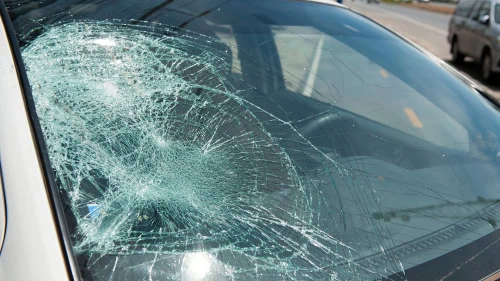
A crack is different. It’s a line of separation in the glass that can extend in any direction, and it behaves differently under stress. Temperature changes, road vibration, and even the pressure difference from closing a car door can cause a crack to grow. What starts as a two-inch crack can become a foot-long fracture overnight if temperatures drop sharply — something Long Island drivers know well heading into fall and winter.
The reason this distinction matters isn’t just about repair cost. It’s about what comes next. A chip repair leaves your existing windshield in place, so ADAS calibration typically isn’t required. A crack that forces a full replacement is a different story — especially if your vehicle has a front-facing camera.
Glass expands and contracts with temperature. In the summer, a windshield absorbs heat from direct sunlight and expands slightly. At night, it cools and contracts. If there’s already a crack in the glass, that repeated expansion and contraction works like a slow wedge — gradually pulling the edges of the crack apart.
A chip you’ve been ignoring since August can become a crack by September. A crack that looked stable on a Tuesday morning can reach the edge of the glass by Thursday after a cold night.
Road vibration accelerates this process. Every pothole, every rough patch of pavement — and Long Island has no shortage of either, especially in the spring after a hard winter — sends micro-vibrations through the glass. Those vibrations don’t cause new damage, but they stress existing damage. A crack that might have stayed put on a smooth highway can spread quickly on a beat-up stretch of road.
The other factor is pressure. Closing a door hard, running a car wash, or even a sudden change in cabin air pressure from opening a window at highway speed can push a crack further. None of these things feel significant in the moment, but they all work against you when there’s already a fracture in the glass.
The practical takeaway is simple: a chip is something you can schedule. A crack is something you should address quickly. A crack that’s already spreading is something you should address today — because once it reaches the edge of the windshield, repair is no longer an option.
An edge crack starts within roughly two inches of the windshield’s outer border — the area where the glass meets the frame. These cracks are in a category of their own, and not in a good way.
The edge of a windshield is where the glass bonds to the vehicle’s frame. That bond is load-bearing — it contributes to the structural rigidity of the roof in a rollover and supports proper airbag deployment. When a crack originates at or near that bond line, it doesn’t just affect visibility. It compromises the structural integrity of the entire installation. That’s why most quality shops won’t attempt to repair an edge crack regardless of how short it is. The risk isn’t worth it, and the repair rarely holds.
Edge cracks also spread faster than cracks that start in the middle of the glass. The edge of the windshield experiences more stress — from temperature changes, from the flex of the frame, from the constant vibration of driving. A crack that starts at the corner of the glass can reach the opposite side within days under the right conditions. Long Island winters are exactly those conditions: sharp overnight temperature drops, road salt that gets into every gap, and roads that haven’t fully recovered from the previous season.
If you have an edge crack — even a short one — the answer is almost always replacement. And if your vehicle has an ADAS camera, that replacement will require recalibration. That’s not a upsell. That’s just how the system works.
Want live answers?
Connect with a First Class Auto Glass expert for fast, friendly support.
Not every piece of windshield damage leads to the same outcome. A small bullseye chip in the lower corner of the glass is a very different situation from a star break behind the rearview mirror or an edge crack spreading toward the A-pillar. Understanding the type of damage you’re dealing with — and where it sits — is the first step toward knowing what you actually need.
The main damage types you’ll encounter are bullseye chips, star breaks, combination breaks, floater cracks, stress cracks, and edge cracks. Chips with clean, contained impact points are generally the most repairable. Cracks — whether they started as chips that spread or appeared on their own from thermal stress — typically require replacement once they reach a certain length or location. The threshold most shops use is roughly the length of a dollar bill, but location matters just as much as size.
The ADAS camera on most vehicles sits directly behind the rearview mirror, near the top center of the windshield. This position isn’t arbitrary — it gives the camera the widest possible forward field of view while keeping it protected inside the cabin. But it also means that area of the windshield is critical in a way the lower corners simply aren’t.
Damage in the camera zone changes the repair-versus-replace calculation entirely. Even a chip that would normally be a straightforward repair candidate becomes a replacement job if it sits in or near the camera’s line of sight. The reason is that resin, even when injected properly, slightly alters the optical properties of the glass. For normal driving visibility, that difference is imperceptible. For a precision camera calibrated to detect objects at highway speeds, it can introduce enough distortion to affect performance.
Here’s what makes this harder to assess on your own: the camera zone isn’t marked on the windshield. Most drivers don’t know exactly where their ADAS camera sits or how wide its field of view is. A chip that looks like it’s a few inches away from the mirror bracket might still fall within the camera’s operational zone. This is one of the reasons it’s worth having someone who actually knows ADAS systems look at the damage before assuming a repair will handle it.
When replacement is required because of camera zone damage, calibration isn’t optional — it’s part of restoring the system to factory specifications. The camera is physically mounted to a bracket that attaches to the windshield. When the windshield is removed and replaced, even with perfect installation technique, the camera’s position shifts slightly. That shift — even by a single degree — can cause a six-foot discrepancy in object detection at 65 feet. At highway speed, that’s the difference between a system that works and one that doesn’t, even if it appears to be functioning normally.
This is the question we hear most often, and the answer is straightforward: if your vehicle was made after 2016 and has a camera behind the rearview mirror, yes — you need ADAS calibration after a windshield replacement. That’s not a judgment call. It’s a function of how the system is built.
ADAS cameras are calibrated at the factory to operate within extremely tight tolerances. They can’t recalibrate themselves once the windshield is removed. The only way to restore factory-spec performance after a replacement is through professional calibration using manufacturer-approved equipment. There are two types: static calibration, which is performed in a controlled environment using precisely positioned target panels, and dynamic calibration, which involves road-testing the vehicle under specific conditions to verify real-world sensor performance. Some vehicles require both.
We’ve spoken with customers who were told by other shops — including large chain operations — that their vehicle didn’t need calibration. In some of those cases, the customer drove away without incident. In others, lane departure warnings started misfiring, adaptive cruise control behaved erratically, or automatic emergency braking became unreliable. The systems appeared to be working. They just weren’t working correctly. A misaligned camera doesn’t always throw a dashboard warning. It can operate in a degraded state that’s invisible until it matters.
On Long Island, where most daily driving involves highways like the LIE and Sunrise Highway at speeds where ADAS systems are actively engaged, that’s not a theoretical risk. Forward Collision Warning and Automatic Emergency Braking together reduce rear-end crashes by nearly 50% — but only when the camera is properly calibrated. Skipping calibration after a replacement doesn’t just void those statistics. It turns a safety system into a false sense of security.
We perform on-site ADAS calibration as part of every windshield replacement on equipped vehicles. No second trip to a dealer. No separate calibration facility. We come to you — whether you’re at home in Suffolk County or parked at your office in Nassau County — and we handle the calibration the same day as the replacement, using manufacturer-approved equipment. If your vehicle requires both static and dynamic calibration, we handle both.
Most customers with comprehensive coverage also pay nothing out of pocket. Many New York comprehensive policies include full glass coverage, so you often pay little or nothing out of pocket. We handle the insurance paperwork directly, so you’re not navigating that process on your own.
If you’ve got a chip, get it looked at before it becomes a crack. If you’ve got a crack, get it addressed before it reaches the edge. And if you’ve got damage near the top center of your windshield — anywhere near where your rearview mirror mounts — don’t assume a repair will cover it without someone checking whether your camera zone is involved.
The type of damage, its location, and whether your vehicle has ADAS all factor into what the right next step actually is. Most drivers on Long Island are driving vehicles that need calibration after a windshield replacement — they just don’t know it yet.
We’ve completed over 10,000 services across Nassau and Suffolk County since 2016. Every job is handled personally by the owner, with no subcontractors and no shortcuts. If you’re not sure what you’re dealing with, reach out — we’ll give you a straight answer.
Article details:
Share:
Continue learning: