What does windshield replacement really cost on Long Island? The answer depends on your car, and most drivers are surprised by what that means in 2026.
Share:
Summary:
You noticed a chip on the way home from work. Maybe it was the LIE, or maybe it was Sunrise Highway. Either way, it’s there, and now you’re wondering what this is going to cost you. The honest answer is that it depends on your car. For a lot of Long Island drivers, that answer is more complicated than they expect. This guide covers what windshield replacement costs in Nassau and Suffolk County in 2026, why the numbers vary so much, what your insurance probably covers, and what separates a job done right from one that will cause problems down the road.
For a standard sedan without advanced safety tech, windshield replacement in Nassau and Suffolk County typically runs somewhere in the $350 to $900 range. For newer vehicles, meaning anything from roughly 2016 forward with lane departure warning, automatic emergency braking, or a forward-facing camera, that number can climb to $800 or beyond once everything is accounted for properly.
The gap between those ranges isn’t arbitrary. It comes down to the glass itself, the adhesive and installation materials, and if your vehicle requires ADAS calibration after the new windshield goes in. That last part is where most Long Island drivers get caught off guard, and it is worth understanding before you start calling around for quotes.

Most vehicles built from 2016 onward have at least one forward-facing camera mounted near the rearview mirror, behind the windshield. That camera serves as the eyes of your ADAS, which stands for your Advanced Driver Assistance Systems. It powers lane departure warnings, automatic emergency braking, adaptive cruise control, and similar features.
When your windshield gets replaced, even a slight shift in how the new glass sits can throw off that camera’s alignment. We are talking about millimeters here. However, millimeters matter when the system is calculating if your car is drifting out of a lane at 65 miles per hour on the Northern State Parkway.
That is why ADAS recalibration is not optional for these vehicles because it is required. The industry standard is clear: if your vehicle manufacturer requires recalibration after a windshield replacement, it has to be done with equipment specifically designed for that purpose. Skipping it doesn’t just void a warranty. It means your safety systems may not function the way they are supposed to, and you might not know until something goes wrong.
The cost of ADAS calibration adds anywhere from $200 to $500 to the total job, depending on the vehicle and the type of calibration required. Some vehicles need static calibration, which happens in a controlled environment with specific targets. Others require dynamic calibration, meaning driving the vehicle under certain conditions after installation. Some need both. Dealers can charge $600 to $1,000 for recalibration alone, which is a significant number, especially if you didn’t know it was coming.
Over 80% of new vehicles in the U.S. are expected to have at least one ADAS feature by 2025. That means the majority of windshield replacements happening right now on Long Island involve this step. If a provider you are talking to doesn’t bring it up, that is worth paying attention to.
It matters more than most people realize. OEM glass, which stands for original equipment manufacturer, is made to the exact specifications of your vehicle. OEM-equivalent glass is manufactured to match those specs closely, using the same tolerances for thickness, curvature, and optical clarity. Aftermarket glass is a broader category, and quality varies considerably within it.
For a basic vehicle without sensors or cameras, the difference between OEM-equivalent and lower-grade aftermarket glass might be subtle, such as a little wind noise or a slightly less precise fit. For a vehicle with a forward-facing ADAS camera, the difference can be significant. Inferior glass can distort the camera’s field of view, introduce optical inconsistencies, or affect how the sensor reads the road, even after calibration.
OEM glass typically costs $150 to $400 more than lower-grade aftermarket alternatives. That premium reflects the engineering behind it, including the precise curvature, the sensor-compatible coatings, and the manufacturing standards. When you are getting quotes and one number looks unusually low, the glass is usually the first place corners are being cut.
We use only OEM-equivalent glass on every job. We do this not because it’s the marketing-friendly answer, but because it’s the only way to stand behind the work with a lifetime warranty and know the ADAS calibration we perform will hold. The glass and the calibration have to work together. One without the other isn’t a complete job.
Want live answers?
Connect with a First Class Auto Glass expert for fast, friendly support.
For most Long Island drivers, yes, comprehensive auto insurance typically covers windshield replacement. Given that Suffolk County has an 82.2% homeownership rate and the region’s median household income is among the highest in New York State, the majority of drivers here carry comprehensive coverage. The question isn’t usually if you’re covered. It’s if you know how to use that coverage without it costing you more than it should.
One thing a lot of people don’t realize is that you have the right to choose your own auto glass provider in New York, regardless of which shop your insurance company suggests. They can recommend a shop, but they cannot require you to use it.
This is probably the most common reason Long Island drivers hesitate before calling their insurance company. The fear is understandable because nobody wants to see their premium go up because of a rock chip on the LIE. But for comprehensive glass-only claims, a rate increase typically doesn’t happen. Comprehensive claims are treated differently from collision claims because the damage isn’t caused by your driving. It’s caused by road conditions, debris, and weather, which are things outside your control.
That said, insurance policies vary. The honest answer is that your specific policy determines your specific situation, and it is worth a quick call to your provider to understand what you’re working with before assuming anything. We handle the insurance process on your behalf, taking care of everything from paperwork to coordination, so you’re not navigating it alone or spending your lunch break on hold.
For Long Island drivers commuting into the city via the I-495 or sitting in stop-and-go traffic on Route 25, a cracked windshield isn’t just an inconvenience. It can cause you to fail a New York State vehicle inspection. That changes the math on waiting. A chip that could have been repaired becomes a full replacement. A claim you could have filed with zero out-of-pocket expenses becomes a bill you’re covering yourself. The sooner you deal with it, the more options you have.
We work directly with insurance companies and manage the claim from start to finish. You give us your vehicle information and your location, and we handle the rest. For most customers with comprehensive coverage, that means the job gets done and the cost is covered. There are no waiting rooms, no paperwork, and no guessing.
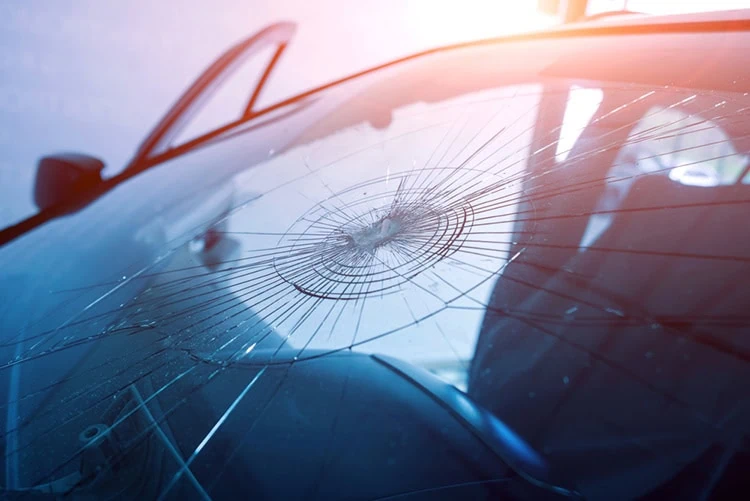
Not every chip or crack means a full replacement, and a trustworthy provider will tell you that upfront, even when replacement is the more profitable job. The general rule is that a chip smaller than a quarter and a crack shorter than three inches can often be repaired. Once a crack extends beyond that, or if it’s in the driver’s direct line of sight, replacement is typically the right call.
Here is the part that catches people off guard: more than 25% of all windshield replacements could have been avoided with an earlier repair. Chips spread. The freeze-thaw cycles that hit Nassau and Suffolk County every winter, bringing salt on the roads, cold mornings, and blasting defrosters, accelerate that process. A chip that’s manageable in October can spider across the glass by February. Long Island’s coastal communities, stretching from Long Beach down the South Shore to the Hamptons, deal with salt air that degrades the rubber seals around windshields over time, which can make existing damage worse faster.
If you’re not sure which category your damage falls into, that’s a reasonable question to ask before committing to anything. We’ll give you a straight answer. If a repair is the right call, we’ll say so. If the damage is too far along, we’ll explain why and walk you through the replacement process, including what your insurance likely covers and if your vehicle needs calibration after.
The other thing worth knowing is that ADAS-equipped vehicles, which once again represents most cars on Long Island roads built in the last decade, need calibration after a windshield replacement regardless of how clean or careful the installation is. It’s not a sign that something went wrong. It’s a required step because the camera’s position relative to the new glass has to be verified and set. We perform that calibration in-house with certified equipment as part of the job, rather than as an afterthought or outsourcing it to a third party.
Windshield replacement cost on Long Island in 2026 depends on your vehicle, your glass, and if your car requires ADAS calibration. For most newer vehicles, it does. For most Long Island drivers with comprehensive insurance, the cost is covered. You just need someone who knows how to handle the claim and do the job correctly from start to finish.
What you’re looking for in a provider is straightforward: someone who uses quality glass, performs calibration in-house, stands behind their work with a real warranty, and doesn’t make you feel like a ticket number. That is what we’ve built First Class Auto Glass around as an owner-operated, Dinitrol certified, New York State certified mobile repair shop, with over 10,000 successful services across Nassau and Suffolk County since 2016.
If you’ve got a chip, a crack, or a windshield that’s already been replaced somewhere else and something doesn’t feel right, reach out to First Class Auto Glass. We will tell you what you’re dealing with and what it will take to fix it right.
Article details:
Share:
Continue learning: