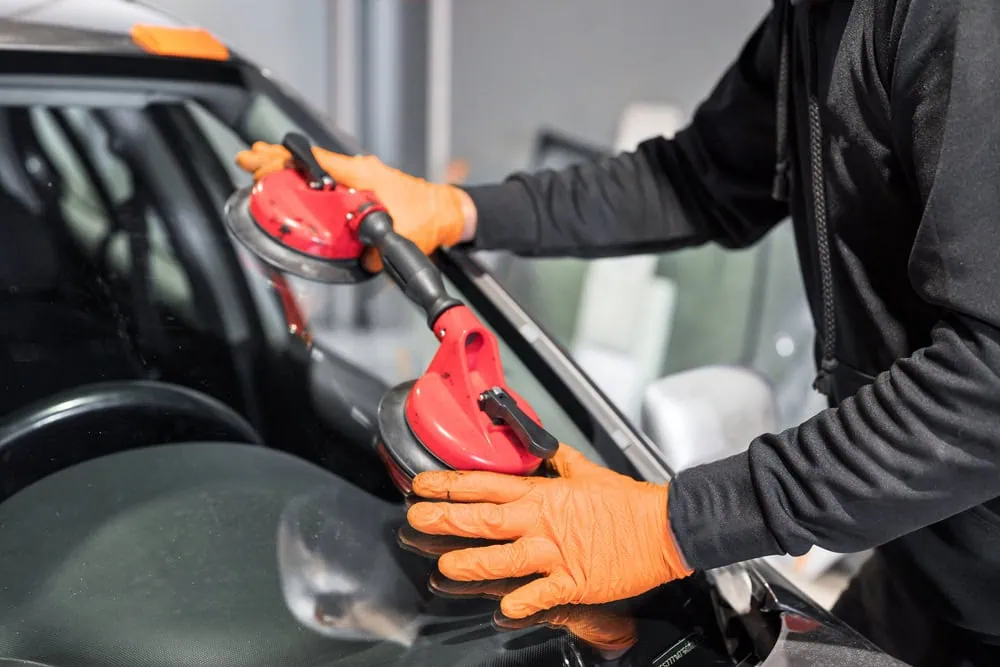
Just bought a car with lane assist or auto braking? Here's what your dealer probably didn't tell you about windshield work and ADAS calibration.
Share:
Summary:
You just bought a new car. It has lane-keeping assist, automatic emergency braking, maybe adaptive cruise control. The dealer walked you through the infotainment system. Nobody mentioned what happens when your windshield gets chipped on the highway and needs to be replaced.
That’s where most new car owners get caught off guard. The windshield gets swapped out, the keys get handed back, and somewhere down the road — sometimes literally — something feels off. Or a warning light comes on. Or you find out later that the camera behind your windshield was never recalibrated after the glass was replaced.
This guide is for drivers who want to understand ADAS calibration before that moment arrives.
Most of the safety features in a modern vehicle — lane departure warnings, automatic emergency braking, forward collision alerts — rely on a forward-facing camera mounted at or near the top of your windshield. That camera is calibrated at the factory to read the road at a precise angle. When your windshield is removed and replaced, even a perfect installation shifts that camera’s position slightly.
That slight shift matters more than most people expect. A camera that’s off by just one degree can misread lane position by 10 feet at a distance of 300 feet. At highway speeds, that’s not a minor error — it’s the difference between a system that works and one that steers you toward the shoulder while appearing completely normal.
ADAS calibration is the process of resetting that camera to its original factory specifications after the windshield has been replaced. It’s not an upsell. It’s a required step that most major automakers build into their service procedures.
More than most people realize — and the number has climbed fast. In 2016, roughly one in four vehicles on the road required ADAS calibration after a windshield replacement. By the 2023 model year, that number had jumped to nearly nine out of ten vehicles. If your car was built in the last several years and has any kind of driver assistance feature, there’s a strong chance it falls into that category.
The reason for the shift is simple: ADAS features have gone from optional extras on luxury trims to standard equipment across almost every segment. Automatic emergency braking alone is now required on most new vehicles sold in the U.S. Features like lane departure warning, blind spot monitoring, and rear cross-traffic alert have crossed the 50% market penetration threshold.
What this means practically is that if you bought a car in the last five to seven years, your windshield replacement is almost certainly a two-part job — glass and calibration. The glass part is visible. The calibration part is invisible, which is exactly why so many drivers don’t know it happened or didn’t happen.
The risk of skipping it isn’t always obvious right away. A miscalibrated camera may not trigger a warning light. The system may appear to function normally. But research from IIHS has shown that a misalignment as small as 0.6 degrees can cut automatic emergency braking reaction time in half. That’s not a theoretical concern — it’s a measurable safety gap that exists between a calibrated system and one that was never reset after glass work.
If your car has any driver assistance features and you’re getting windshield work done, ask directly whether calibration is included. If the shop isn’t bringing it up, that’s worth paying attention to.
Not all ADAS calibration looks the same, and the type your vehicle requires depends on the make, model, and the specific camera system installed. There are two main approaches: static calibration and dynamic calibration. Some vehicles require one. Some require both.
Static calibration is performed with the vehicle parked in a controlled environment. A calibration target — a specific pattern or image — is placed at a precise distance and angle in front of the vehicle. We use manufacturer-specified measurements and a scan tool connected to the vehicle’s computer to walk the camera system back to its factory settings. The whole process happens without the car moving. It requires a level surface, adequate space, and the right equipment for that specific vehicle’s system.
Dynamic calibration works differently. The vehicle has to be driven on a road with clearly marked lanes, at a specific speed, under certain lighting and weather conditions. The camera system recalibrates itself using real-world input as the car moves. Some vehicles can only do this type of calibration. Others that primarily use static calibration may also require a short dynamic drive to confirm the reset.
Honda is a well-known example of a vehicle that often requires both. The Honda Sensing system — which bundles collision mitigation braking, lane keeping assist, adaptive cruise control, and road departure mitigation — has specific calibration requirements that go beyond what a static-only procedure can accomplish. That’s part of why Honda calibration tends to be quoted higher than average when you call a dealership.
When you’re evaluating a windshield calibration service, it’s worth asking which types we perform and whether we look up the OEM procedure for your specific vehicle before we start.
Want live answers?
Connect with a First Class Auto Glass expert for fast, friendly support.
The combination of heavy truck traffic on major routes, aggressive freeze-thaw cycles in winter, and a vehicle fleet that skews toward newer, ADAS-equipped cars means that the calibration question comes up constantly — and many drivers are encountering it for the first time.
The good news for most drivers is that New York State’s zero-deductible glass law means that windshield repair or replacement typically costs nothing out of pocket if you carry comprehensive coverage. What many people don’t realize is that ADAS calibration is generally included in that same insurance claim. The total job — glass and calibration — can come out to zero for most customers.
The key is working with a shop that knows how to handle the claim correctly and includes calibration as part of the service rather than flagging it as a surprise at the end. We handle the insurance paperwork so calibration gets bundled into the claim from the start, not added as a separate line item after the glass is already installed.
Honda is one of the most common vehicles in the area, and Honda Sensing has been standard equipment across most of the lineup for several years now. That means a large number of local drivers are going to encounter the Honda ADAS calibration question at some point — usually right after they’ve been quoted for a windshield replacement.
Honda calibration has a reputation for being more involved than most. The Honda Sensing system often requires both static and dynamic calibration procedures, which means more time, more equipment, and typically a higher cost than a vehicle that only needs one type. Many dealerships quote $600 to $1,000 for the calibration alone — separate from the windshield replacement itself.
That’s a real number, and it catches a lot of Honda owners off guard. The assumption is often that the windshield replacement covers everything. Then the service advisor mentions calibration as a separate line item, and suddenly a job that should have been covered by insurance has an unexpected out-of-pocket component — or the driver is being sent to a second location to have it done.
The better path is working with a shop that performs Honda ADAS calibration on-site, as part of the same appointment as the glass work, and that handles the insurance claim in a way that includes calibration from the start. When calibration is bundled into the claim correctly, most Honda owners with comprehensive coverage pay nothing. The problem isn’t the cost itself — it’s that many shops either don’t do calibration in-house or don’t think to include it in the insurance paperwork until the customer asks.
If you drive a Honda and you’re getting windshield work done, ask specifically about Honda Sensing calibration before you book. Ask whether we perform both static and dynamic procedures. Ask whether it’s included in the insurance claim or billed separately. Those three questions will tell you a lot about whether the shop actually knows what they’re doing.
This is the question most drivers don’t think to ask until after the fact, which is part of the problem. The short version: your safety systems may appear to work while being dangerously off. And you may not find out until they fail at the exact moment you needed them.
A miscalibrated forward-facing camera doesn’t always throw a warning light. The system doesn’t necessarily go offline or display an error code. In many cases, the car behaves normally under ordinary conditions — steady highway driving, clear roads, no sudden obstacles. The gap shows up in edge cases. A vehicle that pulls out in front of you. A car that stops short in heavy traffic. A curve that your lane-keeping system reads slightly wrong. Those are the moments when a fraction of a degree of misalignment becomes a real-world problem.
IIHS data shows that automatic emergency braking reduces rear-end crashes by 50%. That’s the system working correctly. A system that’s out of calibration can have its reaction time cut in half. The safety margin you thought you had is significantly smaller than it appears.
Beyond the safety issue, there are practical consequences. Some automakers specify that ADAS recalibration is required after windshield replacement as a condition of maintaining the vehicle’s safety systems under warranty. If you skip calibration and later file a claim related to a safety system failure, an insurer or manufacturer could argue that the system wasn’t properly maintained. That’s not a hypothetical — it’s a documented risk that shops with calibration expertise routinely flag for customers.
If a shop replaces your windshield on a 2016 or newer vehicle with a forward-facing camera and doesn’t bring up calibration at all, that’s a red flag. It doesn’t mean the shop is dishonest. It may mean they don’t have the equipment to do it and would rather not raise the issue. Either way, you’re left with a gap that matters.
The bar isn’t complicated, but it does require asking the right questions. A shop worth trusting will bring up calibration before you do. We know what type your vehicle requires — static, dynamic, or both. We use manufacturer-specific procedures, not a generic process that works approximately for most cars. And we can tell you clearly whether calibration is included in your insurance claim or not.
We offer mobile ADAS calibration service, which eliminates the two-appointment problem entirely. You don’t have to get your windshield replaced at one shop and then drive to a dealership for calibration. We can handle both at your home or office, in a single visit, and manage the insurance claim from start to finish.
If you’re a new car owner trying to figure out what you actually need — or you’ve already had windshield work done and you’re not sure calibration was handled — we’re happy to answer questions before you book anything. Contact First Class Auto Glass to discuss your vehicle’s specific calibration needs.
Article details:
Share:
Continue learning: