
Not every chip means a full replacement. Here's how experts actually decide — and why acting fast matters more than you think.
Share:

Summary:
You walked out to your car this morning and there it was — a chip, a crack, or something in between. Now you’re wondering whether it’s serious, whether insurance covers it, and whether you actually have to deal with it today. The honest answer is: it depends on four things. Size, depth, location, and whether the damage sits in your direct line of sight. Get a handle on those four factors and the decision becomes a lot clearer. We’ll walk you through how it works, what it means for newer vehicles with cameras and sensors, and why acting sooner rather than later is almost always the right call.
Not all windshield damage is the same, and the type of damage you’re dealing with shapes the decision before anything else does. A bullseye chip — the kind that looks like a circular impact point — is one of the most repairable types, provided it hasn’t spread. Star breaks, which radiate outward from a central point, and combination breaks that show both patterns are also strong candidates for repair when they’re caught early.
Edge cracks are a different story. A crack that starts within two inches of the edge of the glass tends to compromise the structural bond between the windshield and the frame, which usually means replacement rather than repair. Floater cracks — ones that appear in the middle of the glass without a clear impact point — can go either way depending on how long they are and how deep they run.
The type of damage tells you what you’re dealing with. The four factors tell you what to do about it.
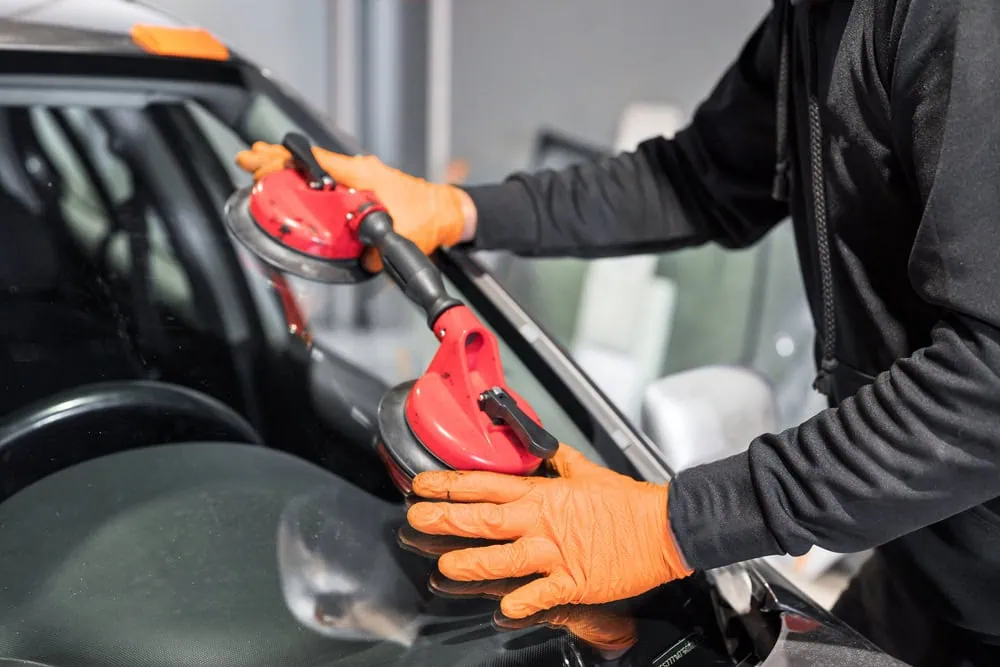
The general industry benchmark is that cracks up to about three inches long are repairable, and in some cases modern resin technology can handle slightly longer damage. But size is only one part of the equation, and it’s the part that gets overemphasized.
Depth matters just as much. A crack that only penetrates the outer layer of the laminated glass is a repair candidate. One that goes all the way through both layers — or comes close — typically isn’t, because the structural integrity of the glass has already been compromised and resin can’t restore that.
Location is the third factor, and it overrides size more often than people expect. A crack in your direct line of sight — even a short one — may still require full replacement because the repair process, while effective, can leave a subtle optical distortion. That distortion is acceptable in the corner of a windshield. It’s not acceptable where you’re looking when you drive.
The fourth factor is proximity to the edge. Cracks within about two inches of the windshield’s edge tend to spread faster and destabilize the glass more quickly, which is why they usually push the decision toward replacement even when the crack itself is short.
Here on Long Island, this four-factor evaluation becomes especially time-sensitive. The freeze-thaw cycles that hit Suffolk and Nassau County from late fall through early spring are genuinely brutal on glass. A small crack that sits overnight in near-freezing temperatures and then warms up in the morning sun can double in length before you’ve finished your commute. What would have been a quick repair on Monday can easily become a full replacement by Wednesday.
A chip is the best-case scenario in auto glass damage, and the window to keep it that way is shorter than most people realize. Chips up to roughly the size of a quarter — bullseye, star, or combination — are almost always repairable when addressed promptly. The resin injection process fills the void, restores clarity, and prevents the chip from spreading into a crack.
What most people don’t know is how quickly that window closes. Temperature swings are the main culprit. When the air inside a chip heats up during the day and contracts at night, the stress on the surrounding glass increases with every cycle. A chip that’s been sitting through a Long Island winter week — cold nights, warm afternoons, road salt kicked up on the LIE or the Northern State — is under constant mechanical stress. At some point, it gives.
The other thing worth knowing is the DIY repair kit temptation. Those kits are available at any auto parts store and they look like a reasonable solution. The problem is that professional repair has about a 70% success rate, while DIY kits come in around 40%. A failed DIY attempt doesn’t just leave you with a bad-looking chip — it can contaminate the damage in a way that makes professional repair impossible. At that point, the only option is a full replacement. A chip that would have been covered at zero cost under your comprehensive insurance policy becomes a full replacement job because of a $15 kit that didn’t work.
If you have comprehensive coverage in New York, there’s a good chance a chip repair costs you nothing out of pocket. Getting it evaluated quickly is almost always worth it.
Want live answers?
Connect with a First Class Auto Glass expert for fast, friendly support.
If your vehicle was made in the last several years, there’s a strong chance your windshield isn’t just glass — it’s part of your car’s safety infrastructure. Front-facing cameras, lane departure sensors, automatic emergency braking systems, and other ADAS features are mounted to or calibrated through the windshield. When that glass gets replaced, those systems need to be recalibrated before they work correctly again.
This is the part of the repair-vs-replacement decision that most guides, and most shops, skip entirely. It matters because it changes the real cost and complexity of a replacement — and it changes what you should be looking for in whoever does the work.
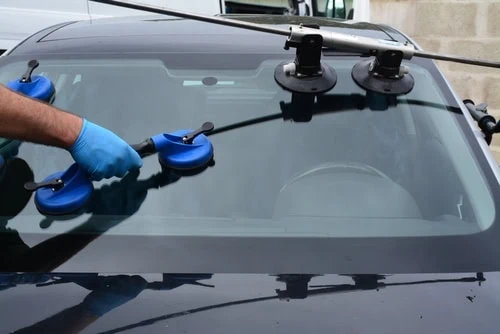
For most newer vehicles, yes. More than 80% of new cars sold in the United States now have at least one ADAS feature, and recalibration is required in roughly 80% of new windshield replacements. That’s not a niche concern — it’s the standard situation for the majority of vehicles on Long Island roads today.
The recalibration process involves resetting the camera and sensor positions relative to the new glass so the system reads the road correctly. When it’s done right, your lane-keeping, emergency braking, and blind-spot systems work exactly as they should. When it’s skipped or done incorrectly, those systems can give false alerts, fail to respond, or behave unpredictably — and you may not notice until something goes wrong.
Here’s the practical problem: not every auto glass shop has the equipment or the certification to perform ADAS recalibration. Many general glass shops don’t. That means a customer who gets a windshield replaced at a shop that can’t calibrate on-site has to make a second trip — usually to a dealership — to get the systems reset. That adds time, adds cost, and adds the kind of inconvenience that nobody planned for.
New York recently passed legislation requiring glass shops to inform customers whether ADAS recalibration is required and whether it meets manufacturer specifications. We handle ADAS recalibration on-site, as part of the same appointment. No second trip to a dealer. No separate calibration facility. The work gets done correctly, in one visit, at your home or your office.
**Does insurance cover windshield repair in New York?**
For most drivers with comprehensive coverage, chip repairs are covered with little to no out-of-pocket cost. New York allows insurers to offer optional zero-deductible glass coverage, which means repairs often cost you nothing at all. Replacements may involve a deductible depending on your specific policy. We handle the full insurance claims process — the paperwork, the billing, all of it — so you don’t have to spend time on hold with your insurer to figure it out.
**How long does windshield repair actually take?**
A chip or crack repair typically takes 30 to 45 minutes, done on-site wherever you are. A full replacement runs 60 to 90 minutes. We come to you — your driveway, your workplace, wherever is most convenient — so there’s no drop-off, no waiting room, and no arranging a ride.
**Will a repaired chip be visible afterward?**
In most cases, the repair will be nearly invisible. There may be a very faint trace of where the chip was, but it won’t distort your vision and it won’t be noticeable under normal driving conditions. If the damage is in your direct line of sight and the repair can’t meet that standard, we’ll tell you — and replacement will be the right call.
**What if I wait and see whether the chip spreads?**
That’s the most common mistake, and it’s an understandable one. But on Long Island, where temperatures swing hard between seasons and road debris is a year-round reality, waiting usually means the chip spreads. A chip that qualifies for a quick, often free repair today can become a crack that requires full replacement by next week. The cost difference is significant.
**Is a mobile service as reliable as a shop?**
We are a New York State certified mobile repair facility — not a van with tools in the back. Every job is performed by the same person, the owner, with 20-plus years of experience and Dinitrol certification. No subcontractors, no rotating crews. Over 10,000 services completed since 2016 across Suffolk and Nassau County. The work meets the same standards as any fixed facility, and the lifetime warranty covers every job for as long as you own the vehicle.
Size, depth, location, and line of sight — those four factors decide almost every case. Chips and short cracks caught early are usually repairable, often at no cost to you. Damage near the edge, in your sightline, or deep enough to compromise both layers of the glass typically means replacement. And if your vehicle has ADAS systems, the shop you choose needs to be able to handle recalibration on-site — not send you somewhere else afterward.
The longer you wait, the fewer options you have. That’s especially true on Long Island, where the climate and road conditions are genuinely hard on glass year-round.
If you’re not sure what you’re dealing with, the best move is a quick professional assessment. First Class Auto Glass serves Suffolk and Nassau County with same-day mobile service — reach out and we’ll tell you exactly what you need, without the runaround.
Article details:
Share:
Continue learning: